


Can a rice field use less water and release less methane? Alternate wetting and drying, usually shortened to AWD, offers one route. The important question is whether farmers can manage the water reliably enough to deliver the benefit.
This explainer looks at an established farming practice, not a newly announced breakthrough. It separates the biological mechanism, evidence on emissions and the practical challenges of applying it across Southeast Asia.
How alternate wetting and drying works
AWD allows an irrigated rice field to drain between periods of flooding. Farmers monitor the water level and irrigate again at an appropriate threshold. A perforated tube can help reveal water below the soil surface. Drying periods inhibit methane-producing microbes, reducing methane formation.
The International Rice Research Institute’s AWD guidance describes water savings of around 30% and methane reductions of 30–70% without a yield penalty under the conditions it describes. These are reported benefits of managed AWD, not guaranteed results for every field.
“Drying” therefore means a controlled stage in an irrigation cycle. It should not be read as an instruction to leave a crop without water indefinitely. Local agronomic guidance matters more than copying a headline percentage.
Less methane does not mean every emission falls
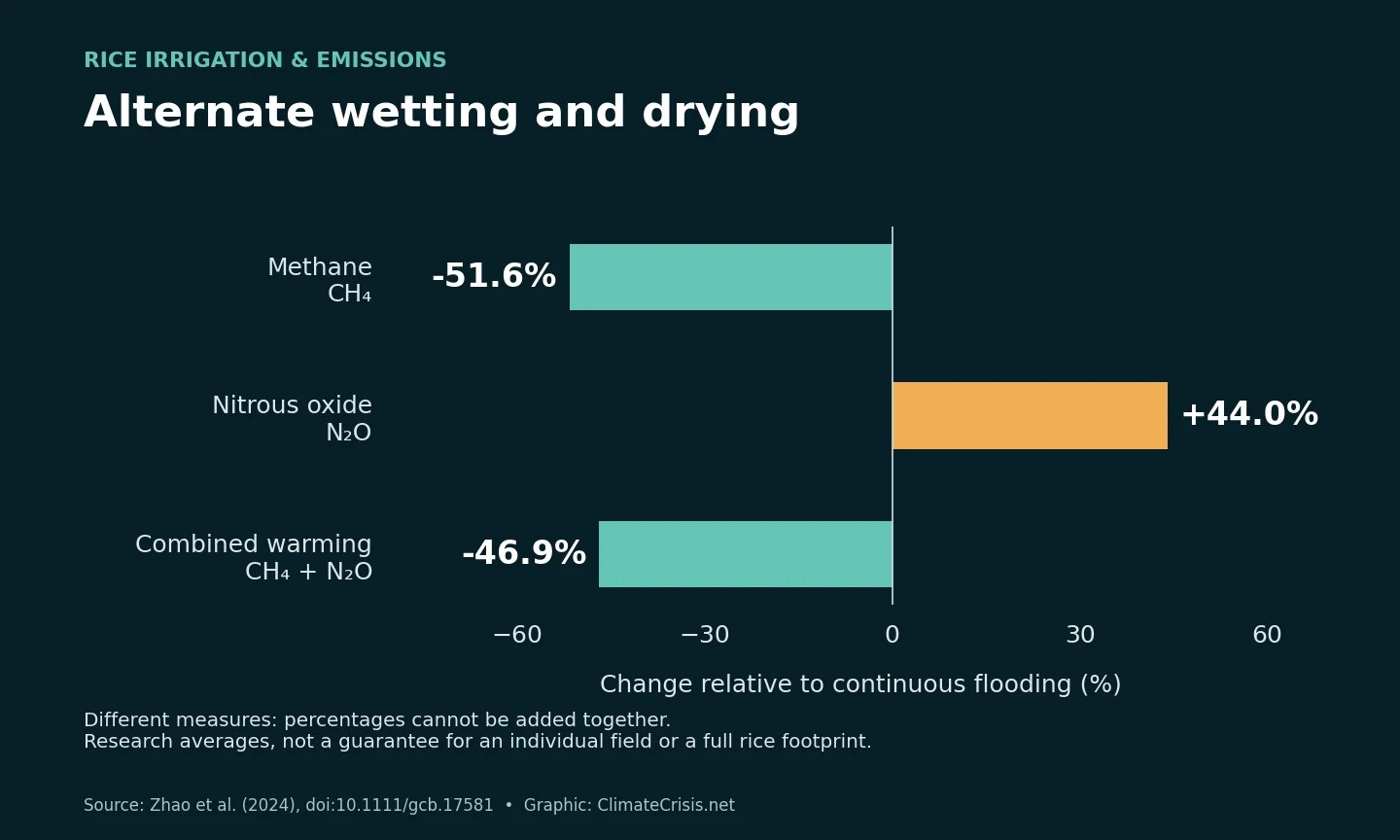
A 2024 meta-analysis by Zhao and colleagues, published in Global Change Biology, compared AWD with continuous flooding. It reported methane emissions 51.6% lower on average, while nitrous oxide emissions increased by 44.0%. The combined warming potential of those two gases fell by 46.9%.
Those percentages describe different quantities. They cannot be added or subtracted to calculate the combined effect: the gases start from different amounts and have different warming effects. The combined result also does not represent the full footprint of producing, milling, transporting and cooking rice.
The study found that soil, climate and management conditions influence outcomes. Its average is evidence across the studies assessed, not a prediction for an individual farm. The chart above shows the reported relative changes; it is not a farm-level emissions inventory.
Why irrigation access can decide whether it works
Consider two farmers. One can decide when to run a pump. The other receives water through a shared canal on a fixed timetable. Both may understand AWD, but their ability to refill a field at the right time is different.
An IRRI account of research on Philippine adoption from 2000 to 2020 highlights this distinction. It describes stronger results in small pump-based systems and more difficulty scaling AWD in large gravity-fed systems. Infrastructure, incentives and irrigation governance all shaped adoption.
That historical review is not a current adoption count. Its useful lesson is about implementation: distributing a field-water tube cannot by itself make a shared water-delivery system flexible. Training and reliable irrigation need to work together.
Four questions to ask about a low-emission rice claim
Our editorial checklist for evaluating a project or product claim is:
- Compared with what? Ask which farming practice serves as the baseline, and whether it represents the farms involved.
- Which emissions are counted? A methane reduction, a two-gas warming estimate and a complete supply-chain footprint are different measures.
- What happened to yield? Check whether results are reported per hectare, per kilogram of rice, or both.
- How was implementation checked? Look for the location, season, water-management records and explanation of how reductions were estimated.
These questions help readers distinguish a promising practice from a verified claim about a particular harvest. A label alone cannot answer them.
Where rice fits into the wider climate picture
AWD shows why climate reporting needs to look beyond electricity. Food production brings together emissions, water access and livelihoods. A useful assessment considers all three rather than judging a project from one percentage.
The same habit of checking what a number measures applies to our explainer on renewable capacity versus electricity generation. For more reporting across climate science and practical responses, visit Climate Change News.
Evidence note: This article draws on IRRI guidance, a 2021 Philippine scaling review and a 2024 research synthesis. It is an explainer, not a claim that these findings were released today.