


The documentary An Inconvenient Truth was released in May 2006. Two decades of measurement have passed, which is long enough to check its claims against the record rather than against opinion. That is what this page attempts: a scorecard on the film’s scientific argument, its weakest presentational choices, its blind spots and its measurable effect.
This page is independent commentary published by climatecrisis.net. We are not affiliated with, endorsed by, or connected in any way to Al Gore, Participant Media, Paramount, or the film’s producers or distributors. Nothing here is a statement by them. We quote no dialogue from the film; where we describe what it argued, we paraphrase.
What the film actually claimed
Strip away the biography and the slideshow theatrics and the scientific core of An Inconvenient Truth is compact and, for 2006, entirely conventional. Carbon dioxide traps outgoing infrared radiation. Fossil fuel combustion has raised atmospheric CO2 well beyond the range in the ice core record covering the past several hundred thousand years. That increase is warming the surface and the ocean, with consequences including ice loss, sea-level rise and stress on ecosystems. The film argued this was an observed process rather than a projection, and that the appearance of scientific division on the fundamentals was manufactured.
That argument was not novel. It restated the position of the Intergovernmental Panel on Climate Change as it then stood. What was novel was the delivery: a two-hour theatrical release built around graphs, reaching an audience that would never open an assessment report.
What held up
The physical trajectory held up, and in places the film was conservative.
Atmospheric CO2 was just over 380 parts per million when the film was released. In 2025 it reached 425.6 ppm, a 53 per cent increase over the pre-industrial level of roughly 278 ppm. The concentration has not merely kept rising; the annual increments have grown.
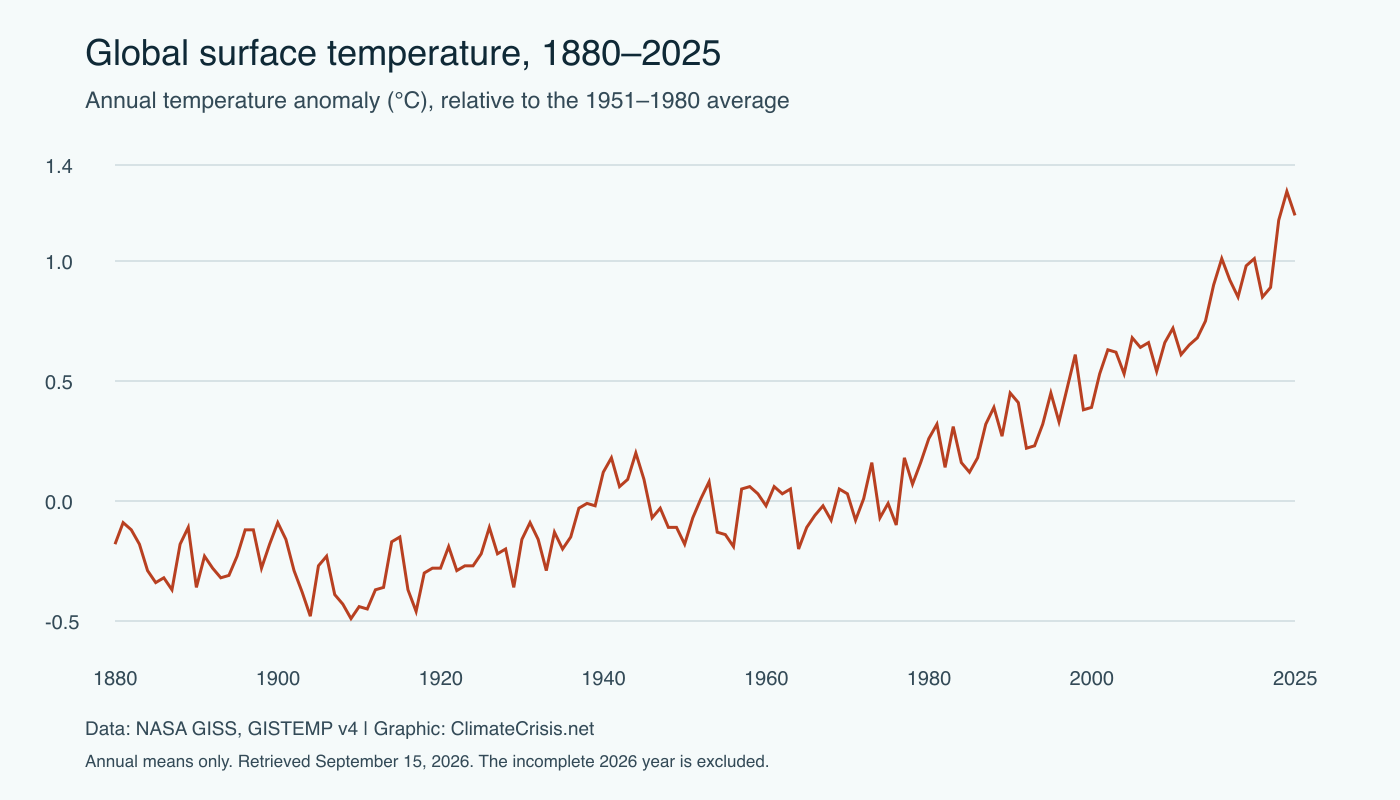
The direction and rough magnitude of warming held up. Global mean surface temperature in 2006 stood around 0.8°C above pre-industrial. In 2025 it was approximately 1.43°C, among the three warmest years on record, and reached without an El Niño to lift it.
Ocean heat accumulation held up, and it is arguably the strongest single line of evidence in the field. The oceans have absorbed almost 90 per cent of the excess energy trapped over the past half century, and 2025 was the warmest year on record for global ocean heat content. The series rises almost monotonically, largely indifferent to volcanic eruptions and the El Niño cycle: the plainest confirmation that the planet retains more energy than it radiates.
Arctic ice decline held up, and here the film understated the case. In 2025 the maximum Arctic sea ice extent was the lowest in the 47-year satellite record. Ice older than four years, the thick multi-year cover that once dominated the basin, fell to 95,000 square kilometres in September 2025 from roughly 1.5 million in the 1980s. The Arctic is warming at about three times the global rate. The film’s Arctic sequences, criticised at the time as dramatic, described a slower decline than the one that followed.
Sea level held up as a trend, if not as a presentation: a record high for the fourteenth consecutive year, about 111.2 millimetres above the 1993 average, rising at close to 3.5 millimetres per year and accelerating.
The attribution case held up most completely of all. In 2006 detection and attribution was a specialist field with a limited toolkit; it can now assess individual heatwaves and rainfall events within weeks. The conclusion the film asserted, that observed warming is dominated by human emissions, has been strengthened by every subsequent IPCC cycle.
What was overstated
The most-cited critique of the film is a 2007 English court case, almost universally misdescribed in both directions.
The case is Dimmock v Secretary of State for Education and Skills [2007] EWHC 2288 (Admin), heard in the High Court of Justice of England and Wales in September and October 2007, with judgment by Justice Michael Burton. It was brought by Stewart Dimmock, a lorry driver and school governor from Kent and the father of two sons at a state school. The question was narrow: whether the government could distribute the film to English state schools as a teaching aid, given a statutory duty not to promote partisan political views.
The court did not find the film unscientific. It ruled that the film was “substantially founded upon scientific research and fact” and could continue to be shown. It also found the film carried a degree of political bias such that teachers would be required to explain the context via guidance notes issued alongside it. Nine claimed “errors”, better described as departures from the scientific mainstream, were identified, and the notes were required to address them specifically. Burton characterised these as arising in “the context of alarmism and exaggeration”. The amended note, which identified the nine points explicitly and referred teachers to the IPCC reports, was held sufficient. That is the whole ruling. It is not a debunking, and anyone citing it as one has not read it. Nor is it a clean win: the film was permitted only with corrective material attached.
Three of the nine points show a real weakness in method.
Sea-level presentation and timescale compression. The film’s most memorable sequence showed coastlines redrawn by a sea-level rise on the order of seven metres, the amount released by major ice sheet loss in Greenland or West Antarctica. The volume figure is not in dispute. The problem is that the sequence carried no explicit timescale, and a viewer could reasonably take away an impression of decades. The court called this distinctly alarmist. The mainstream expectation then and now is that such a rise unfolds over centuries to millennia, even if triggered much sooner. Putting no clock on it handed critics their most durable line of attack.
Kilimanjaro. The film used the retreat of the mountain’s glaciers as an emblem of warming. The court noted the consensus that this recession cannot be established as mainly attributable to human-induced climate change; later work points to reduced precipitation and sublimation in a drying regional climate. The ice is retreating, but the attribution was too simple.
Hurricanes. The film connected Hurricane Katrina to warming in a way that read, to many viewers, as direct causation, and the court found insufficient evidence. The science has since moved partly in the film’s favour: attribution work now finds robust links between warming and rainfall intensity, rapid intensification and storm surge, though trends in storm frequency remain contested. Even so, in 2006 the evidence did not support attributing a single named storm.
The pattern is consistent. The overstatements are not in the physics. They are in the attribution of specific, vivid events, and in the removal of timescale from long-run processes.
What it missed
Several major developments of the past twenty years appear nowhere in the film.
Ocean acidification is barely present. Roughly a quarter of emitted CO2 dissolves into seawater, shifting carbonate chemistry and degrading the conditions calcifying organisms need. Ocean acidity has risen around 30 per cent relative to pre-industrial levels. This is a chemical consequence of the same emissions, independent of temperature, and a major risk in its own right.
AMOC weakening is treated through the frame of an abrupt shutdown, already the least likely outcome. The more serious question, which matured after 2006 as continuous monitoring arrays produced long records, is gradual weakening and its consequences for European climate, tropical rainfall belts and ocean carbon uptake. Estimates still vary widely. The distinction between weakening and collapse matters, and the film blurred it.
Tipping points and cascades did not exist as an organised research programme in 2006. Mapping ice sheets, permafrost, monsoons, coral reefs and forest dieback as interacting elements with threshold behaviour is a post-2008 development, and now central to how risk is framed.
The cost collapse in clean energy is the film’s largest miss, and a miss in the optimistic direction. Its implied solution set was conservation, efficiency and political will, because in 2006 clean generation was expensive. Utility-scale solar levelised cost fell roughly 90 per cent between 2010 and 2024, onshore wind roughly 70 per cent, and four-hour battery storage roughly 90 per cent between 2012 and 2025. Solar became the cheapest source of new electricity in history within fifteen years of release. A viewer in 2006 would have come away believing decarbonisation required permanent sacrifice, when the real obstacle proved to be deployment speed, grid capacity and incumbent interests.
Climate justice is largely absent. The film addresses a general “we”. The distributional question, that the countries with the smallest historical emissions face the largest exposure and the least capacity to adapt, is the axis on which two decades of negotiation have turned.
The legacy
The honest answer is that the film’s effect was large, short and contested.
The measurable behavioural effects were real but transient. Research in the Journal of Environmental Economics and Management found that in the two months after release, postal areas within about ten miles of a cinema showing the film saw roughly a 50 per cent relative increase in voluntary carbon offset purchases, with little evidence those purchasers repeated a year later. Survey work found gains in knowledge, concern and stated willingness to reduce emissions. The film sold climate change to a mass audience assessment reports could never reach.
Then there is the polarisation argument, which deserves a hearing on both sides.
The case that the film damaged the cause runs as follows. By fronting the argument with a recent Democratic presidential candidate, it attached climate science to a partisan identity in the United States at the moment American opinion was forming. Before 2006 the partisan gap on whether warming was occurring was modest; over the following decade it widened substantially. On this reading, the film turned a scientific question into a marker of political belonging.
The counter-argument is that this attributes to a documentary a process already well funded and under way. Organised opposition to climate policy predated the film by nearly two decades and was structural rather than reactive. The gap widened in the same period it widened on many other empirical questions, driven by elite cues and sustained messaging rather than one film. On this reading, the film is blamed for the reaction it provoked, a poor standard for judging any public argument. Both accounts fit the polling data, and this page does not settle it.
What a film like this would have to do today
Three checks for a climate-progress claim
Look for an observed result, not only a future pledge.
Check the baseline, boundary, units and period.
Read assumptions, uncertainty and remaining emissions.
The argument no longer needs to be won. Public acceptance of the basic science is high across most of the world, including where climate policy remains contested. The obstacle has moved from belief to implementation: planning permission, transmission lines, industrial policy, the cost of capital in developing economies, and who pays to adapt.
A film made now would be far less interesting to make. It would be about grid connection queues rather than melting ice, about who bears the cost of transition rather than who caused the problem, and about the unglamorous fact that the technology is already cheaper and the delay is political. It would attach a timescale to every claim. And it would face a harder constraint than An Inconvenient Truth did: an audience that already agrees, and still is not moving fast enough.