

New solar farms and wind turbines are changing the electricity system. But a headline about record renewable capacity answers only part of the question that matters to households and businesses: how much electricity actually comes from cleaner sources?
IRENA reported in April 2026 that global renewable power capacity reached 5,149 gigawatts at the end of 2025, after additions of 692 GW during the year. That was a 15.5% annual increase. These are installed-capacity figures for 2025, not a measurement of electricity supplied in 2026. Read IRENA’s announcement.
Capacity measures potential output; generation measures electricity produced
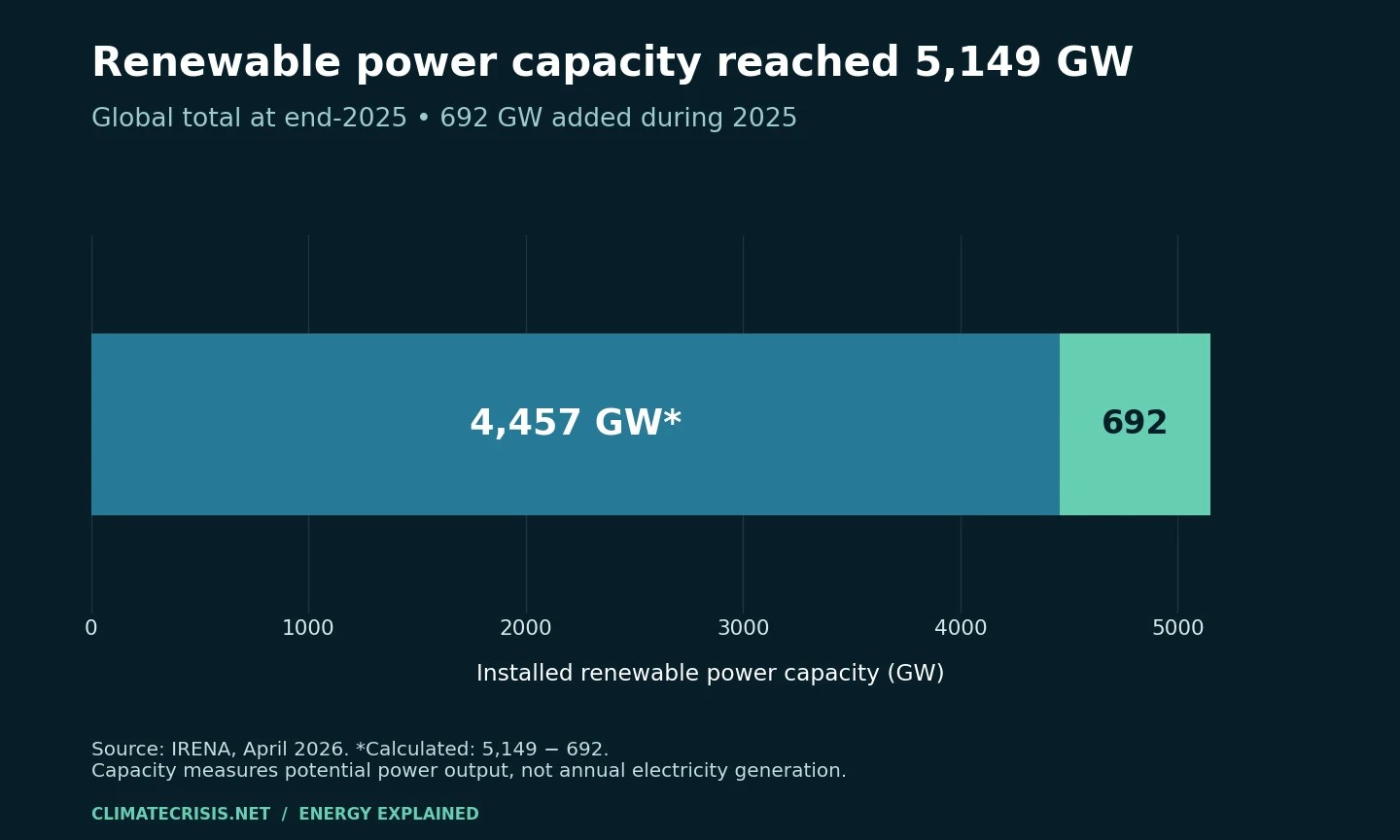
Capacity is the power a generator can deliver under specified conditions. Generation is the energy it produces over a period. Power is commonly reported in megawatts or gigawatts; energy in megawatt-hours, gigawatt-hours or terawatt-hours.
A hypothetical 10 MW plant operating at full output for three hours produces 30 MWh. That arithmetic does not mean it can maintain the same output all day. The US Energy Information Administration explains this distinction and defines capacity factor as actual output relative to the maximum possible output over the same period.
Why a larger renewable fleet does not tell the whole story
Solar output depends on available sunlight, while electricity demand follows its own daily pattern. Storage can move some solar electricity to another time, but charging and discharging involve losses. The US Department of Energy’s solar-and-storage guide explains why timing, storage and demand must be considered together.
The IEA’s Electricity 2026 analysis also identifies grid expansion and more flexible electricity systems as necessary companions to new generation. When potential supply exceeds demand, operators need ways to balance the system. Options include storage, adjusting generation and helping customers shift consumption.
Three questions to ask about a renewable energy claim
- What is the denominator? A share of new capacity, total installed capacity and annual electricity generation are different measures. A percentage without its denominator cannot explain the whole electricity mix.
- Which place and period does it cover? Global figures are useful context, but they do not describe the grid supplying a particular city. An annual average also cannot establish the source of electricity during a particular hour.
- Is it operating or planned? A project announcement, a construction pipeline and commissioned equipment should be labelled separately. Ask for the operating date and measurement period before comparing them.
What this means for Southeast Asian readers
For a reader assessing a local clean-power headline, a useful evidence trail starts with the country’s operating capacity, then follows electricity generation and demand over the same period. A global growth rate alone cannot tell you whether a local electricity supply has become less carbon-intensive.
This matters when reading about electric-car lifecycle emissions or growing demand for air conditioning. Both raise questions about the electricity that equipment uses, not simply the amount of generating equipment installed.
Renewable capacity growth is an important sign of investment and deployment. To judge the electricity transition, keep the next questions visible: what was generated, when was it available, and which demand did it serve?