
Air conditioning is becoming a larger part of Southeast Asia’s energy future. The International Energy Agency’s Southeast Asia Energy Outlook 2026, published on 16 June, projects that the region’s residential air-conditioner stock will triple by 2035 under today’s policy settings. That is a projection about installed equipment, not a claim that electricity consumption or emissions must also triple. The IEA’s executive summary identifies cooling as the fastest-growing established use of electricity in buildings.
The distinction matters for households, utilities and governments. More people can gain access to cooling while each unit of comfort requires less energy. Whether that happens depends on the equipment being sold, the buildings it serves and the electricity that powers it.
What the 2035 projection does—and does not—say
The outlook connects growing AC ownership with higher incomes, expanding cities and rising temperatures. It also points to stronger equipment standards and building codes as ways to moderate future demand. These are conditional scenarios, not a schedule of events that will happen regardless of policy. The report notes that its exploratory scenarios reflect policy settings before the Middle East energy crisis discussed in the outlook. Read the report’s scope and publication details.
There are three different quantities to keep apart: the number of appliances, their cooling capacity, and the electricity they consume. A household buying its first AC increases the stock. Replacing an inefficient unit can reduce electricity use for the same cooling service. Neither change can be understood from an appliance count alone.
Why the electricity system matters
The IEA’s policy-based outlook expects regional electricity demand to more than double by 2050, with buildings and industry driving much of that growth. Data centres add demand concentrated in particular places. Coal remains the largest individual source of generation in the scenarios described, even as lower-emission sources expand. The outlook’s electricity analysis makes clear why demand and supply need to be planned together.
Our reading is that a cooling strategy should be judged on more than annual electricity totals. Planners also need to understand when demand occurs and whether local networks can supply it. That connects this issue with the infrastructure pressures discussed in our ASEAN data-centre explainer.
Cooling capacity is not electricity consumption
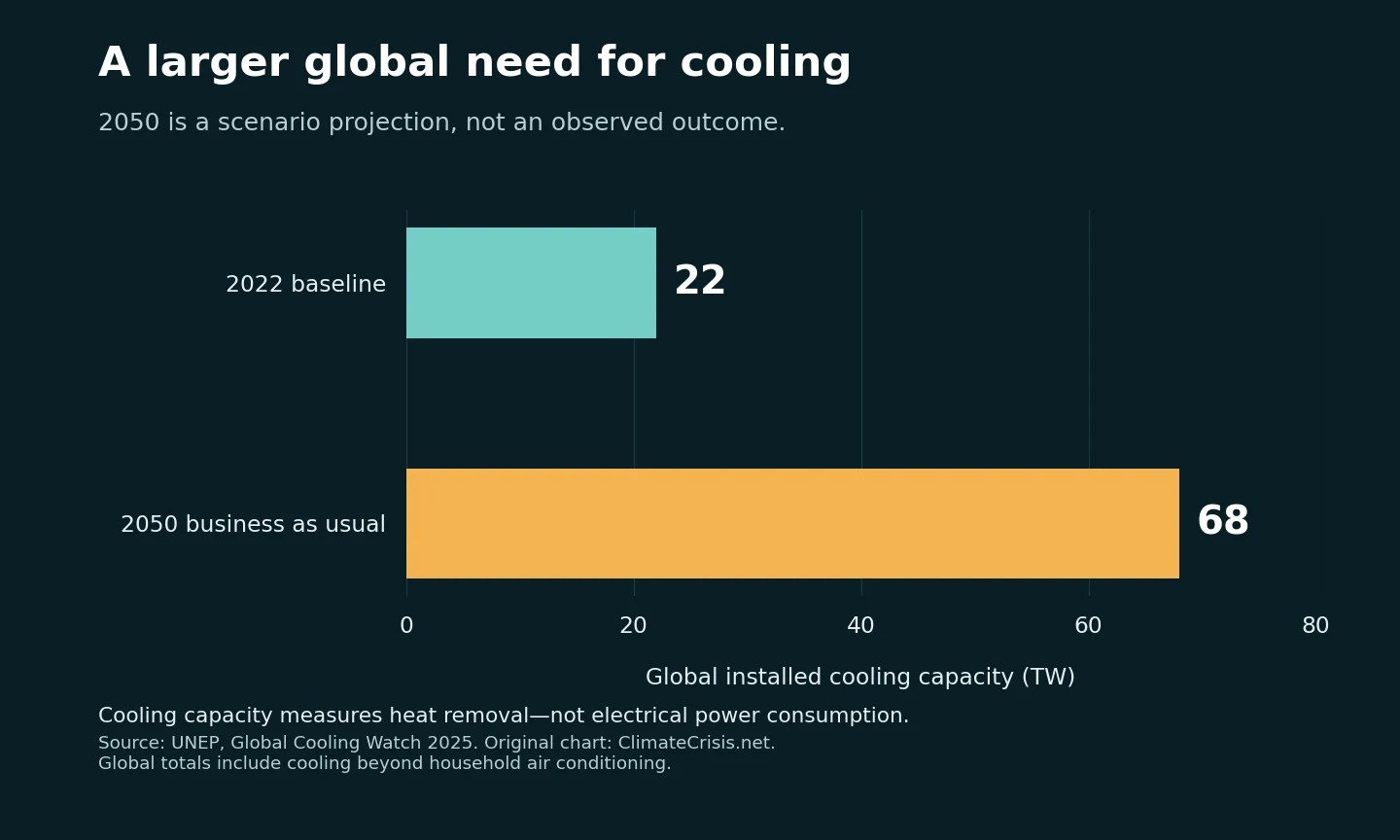
UNEP’s Global Cooling Watch 2025 provides a global comparison. Under its business-as-usual pathway, installed cooling capacity rises from 22 terawatts in 2022 to 68 terawatts in 2050. This includes cooling beyond household air conditioning. The figures describe the ability to remove heat; they are not a forecast of 68 terawatts of electrical demand. UNEP explains the projection and its assumptions.
The accompanying chart shows those two endpoints only. It does not imply a smooth annual growth path, and its global figures should not be presented as Southeast Asian totals.
Buildings and efficient equipment must work together
UNEP calls for starting with passive design and low-energy cooling, alongside efficient appliances and a faster phase-down of climate-warming refrigerants. Its proposed pathway combines these approaches rather than treating an AC purchase as the only response to heat. Cooling access is also an equity question: people in poor housing may face substantial heat exposure while having little control over building improvements.
The IEA’s earlier, 2019 regional cooling study explains two complementary policy tools. Minimum energy performance standards remove inefficient products from the market; labels and public procurement can help shift demand toward better equipment. Building improvements help preserve the benefits of those appliances. That study’s policy discussion remains useful background, although its forecasts should not be confused with the 2026 outlook.
What to watch next
Useful signals include stronger appliance standards, enforceable building requirements, and whether cooling becomes affordable for people currently without it. Counting AC sales captures only one part of the transition. The more useful question is whether the region can deliver dependable cooling with lower electricity requirements and cleaner power.
For the surrounding urban environment, read our guide to why cities retain heat and what can cool them.