


A battery project described as “100 megawatts” sounds large. Yet that number alone cannot tell you how long it can supply electricity. To understand what storage can do for a grid, a business or a home, you need its energy capacity as well as its power rating.
That distinction helps make sense of solar-plus-storage announcements across Southeast Asia. It also makes it easier to compare proposals without assuming that every battery performs the same job.
Power is the delivery rate; energy is the available amount
The US Department of Energy distinguishes two storage ratings: power capacity, usually expressed in kilowatts or megawatts, and energy capacity, usually in kilowatt-hours or megawatt-hours. One describes how quickly energy can be delivered; the other describes how much can be stored.
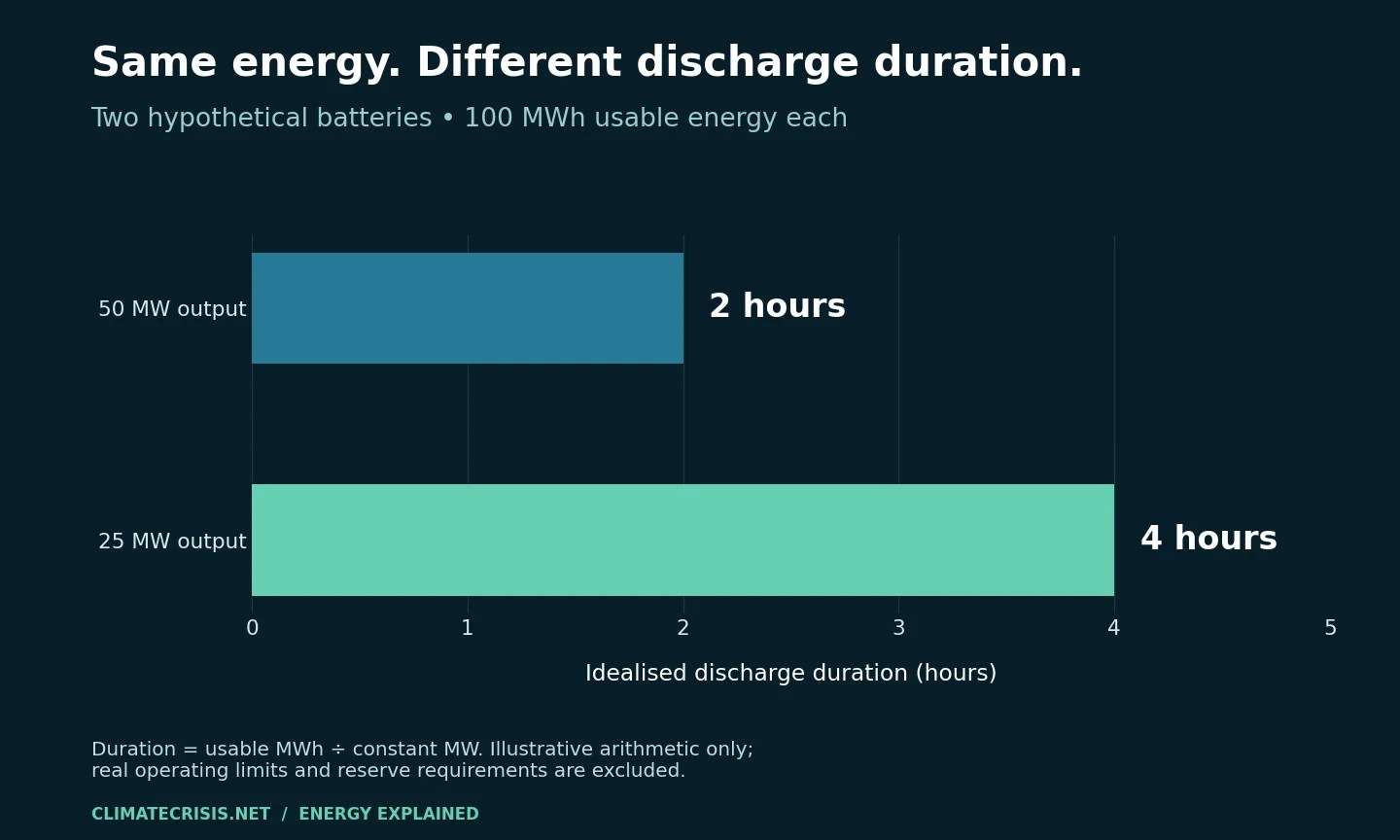
Consider two hypothetical systems, each with 100 MWh of usable energy. A 50 MW system could discharge that amount over two hours at its rated output. A 25 MW system could spread it over four hours. These are simplified calculations, not specifications for actual projects.
Idealised duration = usable energy ÷ discharge power. The chart uses this equation and assumes constant output. Real operating limits, reserve settings and how usable energy is defined must be checked in the manufacturer’s specification.
Why solar and storage are paired
Solar generation and electricity consumption do not always peak together. A battery can charge earlier and discharge later, or help manage short fluctuations in output. DOE notes that storage involves conversion losses, so it does not return every unit of electricity used to charge it.
A storage announcement therefore needs more context than a solar installation’s size. Ask whether the proposed battery is intended for brief grid support, a few hours of energy delivery or backup for selected equipment. Those are different service requirements.
A battery is one part of a flexible grid
The IEA’s Electricity 2026 flexibility analysis places storage alongside grid upgrades and demand response. Demand response means customers shift or reduce electricity use in response to signals or incentives, helping match consumption to available supply.
For example, an operator deciding when to charge a fleet would need to examine the local tariff, charging requirements and electricity supply. Buying a larger battery is not the only question. Changing the timing of demand may also be relevant, where equipment and service requirements allow it.
Questions to ask before comparing projects
- Are both MW and MWh stated? Without both, you cannot calculate the rated discharge duration.
- Is energy capacity nominal or usable? Ask what the published figure includes and which operating limits apply.
- What output must it maintain? A quoted duration is meaningful only alongside the power delivered during that period.
- What is the charging plan? Identify when charging occurs and which electricity supply is used.
- What does the guarantee cover? Look for the stated performance conditions and end-of-warranty capacity, rather than assuming the initial rating lasts indefinitely.
Read the service, not just the headline size
Storage changes when electricity can be used. Its value needs to be assessed against a defined task, with power, energy and operating conditions stated together. A four-hour example should not be read as a promise of all-night or multi-day backup.
For more context, see our explanations of Southeast Asia’s cooling demand and EV lifecycle emissions. Both help connect electricity-system decisions with the equipment people use every day.