
Electric vehicle lifecycle emissions depend on more than what leaves the exhaust pipe. A battery electric car produces no exhaust emissions while driving, but making its battery and generating its charging electricity still have a climate footprint. The useful comparison counts both, alongside the emissions of producing and burning petrol.
For Southeast Asian readers, the key question is how a vehicle performs with the electricity supply, size and driving pattern that actually apply locally. A global average is a starting point, not a result for every household.
Why the question matters in Southeast Asia
The IEA’s Global EV Outlook 2026 reports that Southeast Asian electric car sales more than doubled in 2025, exceeding half a million. Here, “electric cars” includes battery electric cars and plug-in hybrids; more than 90% of the region’s electric car sales were battery electric.
Those figures describe market growth. They do not, by themselves, measure the emissions saved. To answer that question, we need a different kind of analysis.
What a lifecycle comparison includes
A lifecycle assessment follows a car from raw materials and manufacturing through its use. For an electric car, that includes battery minerals and charging electricity. For a petrol car, the comparison must count its fuel supply as well as combustion.
The IEA’s explanation of its lifecycle calculator, published in June 2024, shows why assumptions matter: users can vary vehicle size, powertrain, fuel economy, lifetime and driving profile. They can also change assumptions about electricity emissions and future energy supply.
A fair comparison therefore starts with comparable vehicles and the same transport need. Comparing a small electric hatchback with a much larger petrol vehicle answers a different question from comparing two similar cars.
What the global evidence says—and its limits
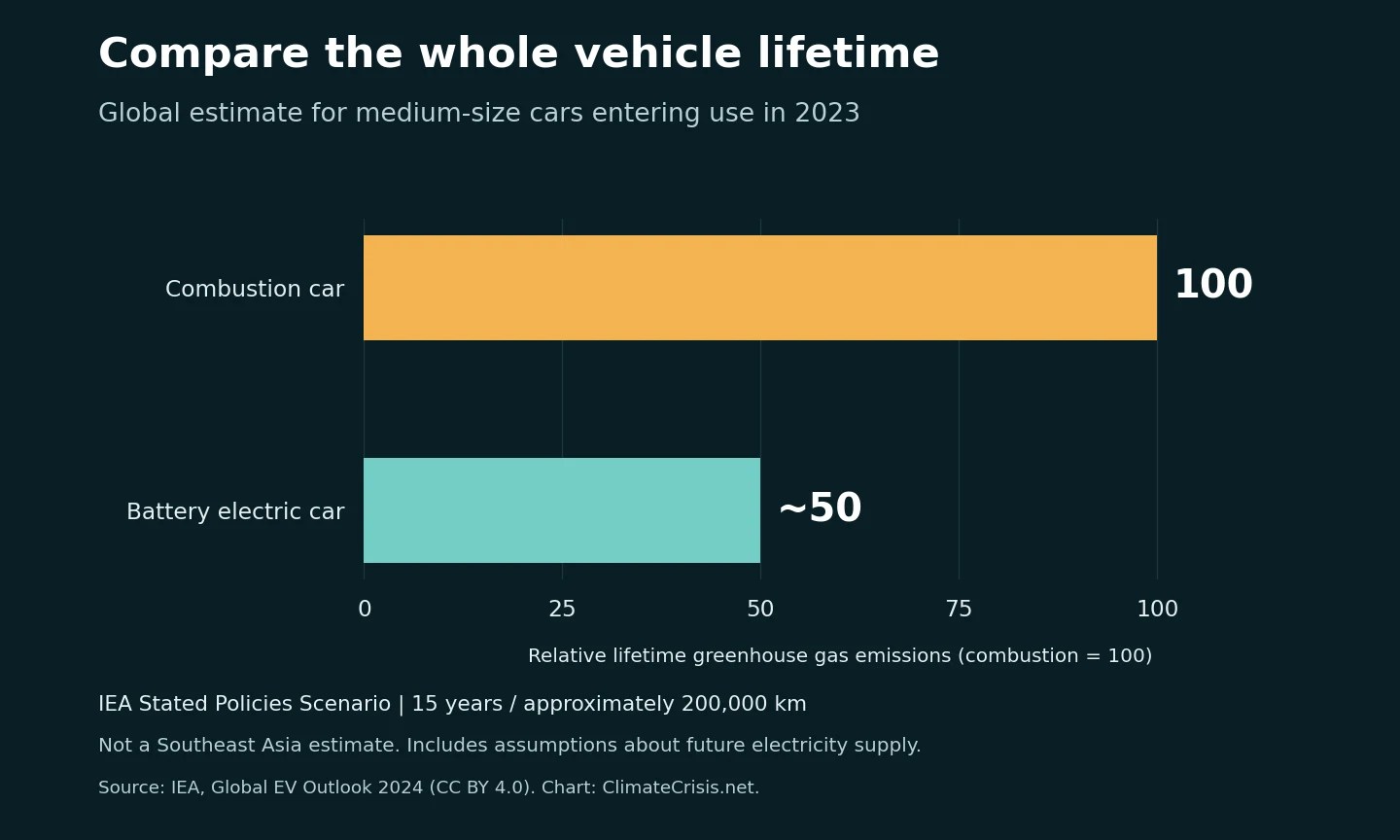
In its 2024 lifecycle analysis, the IEA estimated that a medium-size battery electric car entering use in 2023 would produce roughly half the lifetime greenhouse gas emissions of an equivalent oil-fuelled car, as a global average. The calculation used its Stated Policies Scenario and approximately 200,000 kilometres over 15 years.
The chart accompanying this article turns that approximate relationship into an index: the combustion car equals 100 and the electric car about 50. These are relative values, not grams of carbon dioxide per kilometre. The estimate incorporates a scenario for future electricity supply; it is not a measurement of a completed vehicle lifetime or a country-specific forecast for Thailand, Indonesia or Viet Nam.
Battery production still deserves scrutiny
The IEA’s December 2024 battery supply-chain report identifies battery production and mineral processing as important opportunities to reduce emissions. Cleaner production processes and recycled materials can improve the battery footprint. Recycling also depends on collecting batteries and developing the facilities to process them.
This supports a more useful discussion than treating the battery as either irrelevant or the whole story. Ask how it was made, then include the electricity and driving assumptions for the rest of the car’s life.
Four questions to ask about an EV emissions claim
- Which vehicles? Check the size, battery capacity and whether the comparison is with petrol, a conventional hybrid or a plug-in hybrid.
- Which electricity? Look for the country or region, and whether the calculation holds today’s grid constant or assumes future changes.
- How much driving? Check the assumed lifetime distance rather than treating a percentage as universal.
- What is counted? Distinguish tailpipe emissions, energy-supply emissions and the wider lifecycle.
Our carbon footprint guide explains how boundaries affect an estimate. For the wider travel decision, explore transport choices and practical climate actions.
An emissions claim is most useful when you can see what sits behind it. For electric cars, that means stating the vehicle, electricity supply, distance and timeframe together.